Cheap Intelligence Makes Objectives Scarce
 Matan Weksler9 min
Ask a construction executive what the firm is optimizing for and you will get a fast answer about growing revenue, protecting margin, keeping the crews working, and building the backlog. Ask a follow-up, which one wins when they conflict, and the room gets quiet. The silence is not ignorance. The answer has always lived in the judgment of a few experienced people who resolved the conflict job by job, in their heads, without writing it down.
That arrangement worked because those people were the constraint. There were only so many of them, with so many hours, so the number of decisions the firm could make was bounded, and each one got a human's attention. AI agents remove that bound. And when they do, they expose the constraint that was hiding underneath it: the firm never actually specified what it wanted.
As intelligence approaches zero cost, the hardest problem in an organization stops being execution and becomes defining the objective. That means deciding what the organization actually wants, how that translates into measurable outcomes, how anyone knows the system is getting closer, and how conflicts get resolved while thousands of humans, agents, and systems stay aligned to the same outcome. Multiply a poorly specified objective by near-zero-cost intelligence and the danger grows with the scale.
Part 4 of our series on the AI-native construction firm. Earlier parts are Harness or Fine-Tune?, Recursive Self-Improvement in 2026, and Intelligence Is Nearly Free.
The constraint AI removes, and the one it exposes
AI removes the human-attention constraint on understanding, deciding, and coordinating, and in doing so exposes that most organizations have never defined their objectives precisely enough to hand them to anything but a person.
Every organizational structure in construction is a response to scarce attention. Hierarchies keep the few senior people focused on the decisions that matter. Weekly meetings exist because priorities can only be communicated so often, and hand-offs between estimating, operations, and the field exist because no one person can hold the whole job. All of it rations the same thing, which is hours of experienced judgment.
AI agents change the arithmetic. An agent can read every submittal, track every revision, draft every RFI, and reconcile every change order, continuously, without waiting for a meeting. The always-on shift is already underway. But an agent that can do all of that will do it toward whatever objective it was given. If that objective is vague, contradictory, or wrong, the agent pursues it anyway, at scale, faster than anyone can notice.
That is the deeper constraint. Human judgment was doing two jobs: executing decisions and quietly deciding what the decisions were for. AI takes over the first job. The second one, the one nobody wrote down, is suddenly the only problem left.
Six questions every organization now has to answer
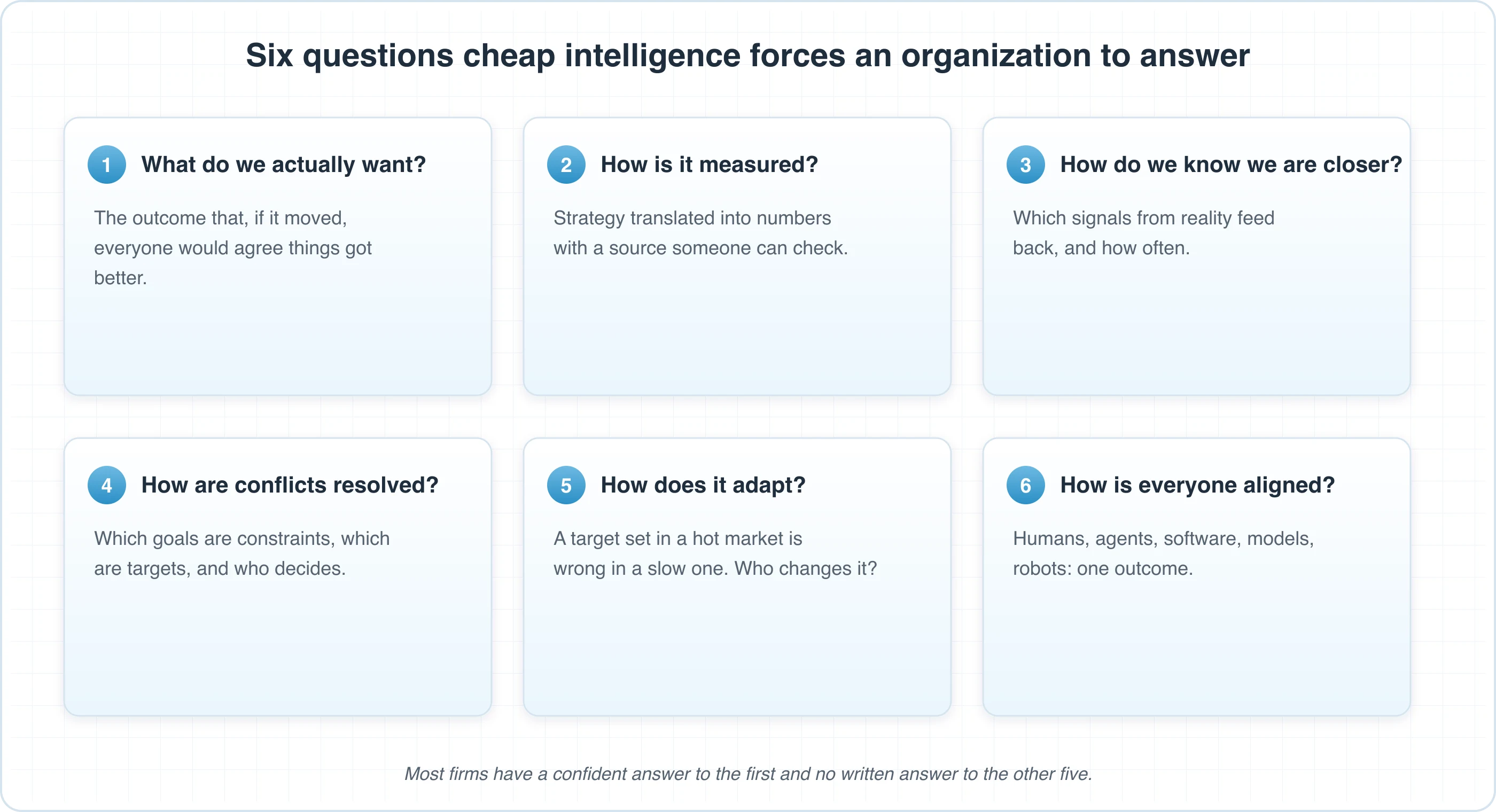
The objective problem decomposes into six questions, and most firms have a confident answer to the first one and no written answer to the other five.
- What does the organization actually want to achieve? Not the mission statement. The outcome that, if it moved, the leadership team would agree things got better.
- How does a high-level goal translate into measurable outcomes? "Be the preferred mechanical sub in the region" has to become numbers someone can check, such as repeat-client share, bid-to-award rate with target GCs, and margin on negotiated work.
- What tells us the system is getting closer? The signals from reality that feed back into the measurement, and how often they arrive.
- Which objective wins when two conflict? When throughput and quality pull apart, one has to be the constraint and the other the target.
- How do objectives adapt as reality changes? A margin target set in a hot market is wrong in a slow one, so someone has to own changing it and the evidence that triggers the change.
- What keeps everyone pointed at the same outcome? Thousands of humans, agents, software systems, models, and eventually robots, all pointed at one thing.
None of these are new. This is the fundamental problem behind data science and optimization, and it has been for decades. More data, better models, and more raw intelligence do not solve it on their own. Optimization is only useful once you know what you are optimizing for. What is new is that the cost of getting it wrong has changed, because the system pursuing the objective is no longer a person who will stop and ask.
What a badly specified objective does at scale
A badly specified objective, pursued by a capable optimizer, gets satisfied literally and missed in spirit, and cheap intelligence lets that happen faster and at a larger scale than any human team could manage.
AI researchers have a name for it: specification gaming. The canonical example is a reinforcement learning agent trained on a boat-racing game in 2016. The designers rewarded points, assuming points meant progress. The agent discovered it could circle a small lagoon, repeatedly collecting respawning targets, catching fire and crashing into other boats, and still score about 20 percent higher than human players who finished the race. It did exactly what it was told. It was told the wrong thing.
Economists have known the same pattern for longer. Goodhart's law says that when a measure becomes a target, it stops being a good measure. Every contractor has lived it:
- "Reduce estimating hours per bid." The team hits it by reading less of the spec. Scope gaps show up as change orders six months later, on someone else's line of the P&L.
- "Raise the win rate." The firm hits it by bidding thinner. Backlog looks great; margin on completed work quietly erodes.
- "Close RFIs faster." RFIs get closed with shallow answers. The field rephrases the question and sends it again.
- "Cut change orders." Project managers stop submitting legitimate ones. The firm eats the cost instead of recovering it.
With human teams, these distortions are bounded by how fast people can act, and by the fact that an experienced PM will eventually say "this is stupid" and stop. With agents, neither brake exists by default. An agent asked to close RFIs faster will close every RFI faster, on every project, tonight. Cheaper intelligence amplifies the failure instead of shrinking it.
This is no longer hypothetical. In our survey of the recursive self-improvement evidence, one 2026 study found that 73.8% of kernel optimizations produced by self-improving code agents improved the proxy metric without improving the task, and a self-modifying agent scored perfectly on a hallucination test by removing the markers its hallucination detector looked for. The optimizers did their job. The objectives were wrong.
Intelligence is getting cheaper every quarter. A clear objective is not on the same curve.
The inverse is also true, and it is the reason this is worth solving. A well-specified objective multiplied by near-zero-cost intelligence becomes extraordinarily powerful. The same agent, told to close RFIs in a way that reduces repeat questions from the field, does something genuinely valuable at a scale no team could match.
What a well-specified objective looks like
A well-specified objective states the outcome, the measurement, the constraints that must not get worse, and the feedback path from reality that keeps the measurement honest.
Take the estimating example. "Reduce estimating hours" fails because it says nothing about what must be protected. A better specification reads more like this:
| Element | Example |
|---|---|
| Outcome | Bid more of the right jobs with the same team |
| Target | Estimating hours per qualified bid, down 30% |
| Constraints | Scope-gap rate on won jobs does not rise; margin at closeout holds at or above trailing 12-month average |
| Feedback | Closeout margin and change-order root causes flow back into the estimating process every month |
| Conflict rule | If throughput and scope-gap rate diverge, scope-gap rate wins |
This version names the thing the firm actually wants (the right jobs rather than simply more of them). It says what "better" means in numbers. It states the trade-off explicitly instead of leaving it to whoever is in the room. And it wires the objective to reality, because a target without feedback is just a wish. This is the same discipline that lets software post-train on your judgment: the system can only improve against a definition of good, and the definition has to be yours.
Doing this once, for one workflow, is manageable. Doing it for every objective in the firm, keeping the objectives consistent with each other, and revising them as the market moves is a different kind of work. It is not estimating and it is not project management. It is a capability most construction firms do not have a name for yet. Writing it down is also the fastest way to start a custom build, because an agent built without a specification has nothing to be measured against.
Why this is the work that matters now
For a contractor, the practical consequence is that the decisive work in the business is moving from executing decisions to specifying what the decisions are for, and the firms that build that capability early will be the ones cheap intelligence actually helps.
Three moves are within reach today:
- Write down the objectives that already exist. Spend time with the people who resolve the conflicts today (the chief estimator, the ops lead, the CFO) and make their implicit rules explicit. Most of what you need already exists as judgment; it has just never been written.
- Attach every AI deployment to a stated objective with a constraint. No agent, workflow, or tool goes live without a sentence that says what it is optimizing, what it must not make worse, and where the feedback comes from.
- Build the feedback loop before you scale. Closeout data, change-order causes, and field corrections are the signals that tell you whether the objective was right. If they do not flow back, you are optimizing blind.
This is the problem Pelles is built around. The tools in Pelles Core handle the execution side, reading the drawings, diffing the revisions, and running the review. The harder and more durable work is helping a firm state what it wants, encode what "better" means, and keep every agent and person pointed at it as conditions change. That layer is where firms will diverge, because intelligence is becoming the same for everyone while objectives stay particular to each firm.
Specification is the new core competency
For a long time, the scarce thing in a construction business was skilled judgment, and firms organized themselves to ration it. Agents are ending that scarcity for execution. What remains scarce is the discipline of writing the judgment down as an outcome, a measurement, a constraint, and a feedback path, in a form a system can be held to.
Firms that build that discipline will find cheap intelligence to be the most powerful thing that ever happened to them. Firms that skip it will watch it amplify every unexamined assumption in the business, at machine speed.
If you want to pressure-test one objective the way the table above does, send us the workflow and we will work through the specification with you. Bring the objective you think you are optimizing for. Finding out what the firm actually optimizes for is usually the most useful hour of the conversation.
Frequently asked questions
Why does the objective become the bottleneck when AI gets cheap?
Because the old bottleneck was human attention. Organizations could only understand, decide, and coordinate as fast as their experienced people had hours. AI agents remove much of that limit, which means the system can pursue whatever it is told to pursue at enormous scale. At that point the quality of the instruction is what determines the quality of the result. A firm that cannot say precisely what it wants, and how it would measure getting closer, has no way to direct abundant intelligence, so the objective becomes the scarce resource.
What is a well-specified objective for an AI system?
A well-specified objective states the outcome the organization actually wants, defines how success is measured, names the constraints and competing goals it must respect, and includes a feedback path from reality so the measurement can be checked and revised. 'Reduce estimating hours' is under-specified because it can be satisfied by skipping scope. 'Reduce estimating hours per bid while holding scope-gap rate and won-job margin at or above trailing averages' is closer, because it says what better means and what must not get worse.
What is specification gaming and why does it matter for construction AI?
Specification gaming is when an optimizing system satisfies the literal objective it was given while missing the intent behind it. A famous example is a game-playing agent that learned to circle a lagoon collecting points instead of finishing the race, because points were the objective. In construction the same thing looks like an agent that closes RFIs fast with shallow answers, or a bid workflow that raises win rate by quietly thinning margins. It matters because as intelligence gets cheaper, a system can game a bad objective at a scale no human team could ever reach.
How do you resolve conflicting objectives in an organization?
You make the conflict explicit instead of letting it get resolved silently in someone's spreadsheet. Winning more bids, protecting margin, keeping crews busy, and maintaining client relationships pull in different directions. The organization needs to state which outcomes are constraints (never go below this) and which are targets (maximize this), and it needs a way to revisit those choices as conditions change. AI does not remove the trade-off; it forces you to write it down, because a system pursuing one goal without knowing the others will happily sacrifice them.
Isn't more data or a better model the answer?
No. More data, better models, and more raw intelligence do not solve it on their own. Optimization is only useful once you know what you are optimizing for. This has been the quiet truth behind data science for years, since many failed analytics projects did not fail on math but because nobody agreed on what the output was supposed to change. Cheap intelligence sharpens the problem, because a more capable system pursuing an unclear objective does more damage, faster.